
Active Warrants in El Paso County
The county's official Records Search page links a warrant search and labels it as warrants issued by the Sheriff's Office. An active warrant means a court or the Sheriff has authorized action, often an arrest. Warrants can come from a missed court date, a bond problem, an unpaid fine, a probation issue, or new court process after an indictment. Not every warrant appears in the public tool, since some are sealed, juvenile, or tied to an active investigation.
El Paso County clusters its warrant functions downtown. The Sheriff's Office Warrants Section sits inside the Downtown Detention Facility, alongside two jail magistrate courts, so booking, magistration, and bonding happen close together. That setup matters when a warrant turns into an arrest and a bond hearing on short notice.
Many El Paso County warrants are routine rather than dramatic. A large share trace back to missed court dates and unpaid fines in traffic and Class C cases, not violent crime. That is one reason the county ties its warrant tool to the same system as criminal cases and citations. Knowing the case behind a warrant often points to the simplest way to clear it.
Types of Warrants in El Paso County
Texas uses several kinds of warrants, and the type tells you what triggered it and how to resolve it. Some come from a judge, some from the failure to appear or pay, and some authorize a search rather than an arrest.
- Arrest warrant authorizes taking a named person into custody.
- Bench warrant is issued by a judge, often after a missed court date.
- Capias is an arrest writ issued after an indictment, a judgment, or a failure to appear.
- Capias pro fine is used to collect an unpaid fine in a fine-only case.
- Search warrant authorizes a search of a place or property.
- Fugitive warrant covers a person wanted in another jurisdiction.
Search warrants follow their own filing path. The District Clerk notes that a search warrant should, when possible, carry the jail magistrate's signature, since a magistrate is on duty around the clock, and that those warrants are filed at the downtown jail.
How to Search El Paso County Warrants
The warrant tool lives on the county's El Paso County Records Search hub. Open the warrant search, enter a name, and complete the security check. The search runs against warrants issued by the Sheriff's Office.
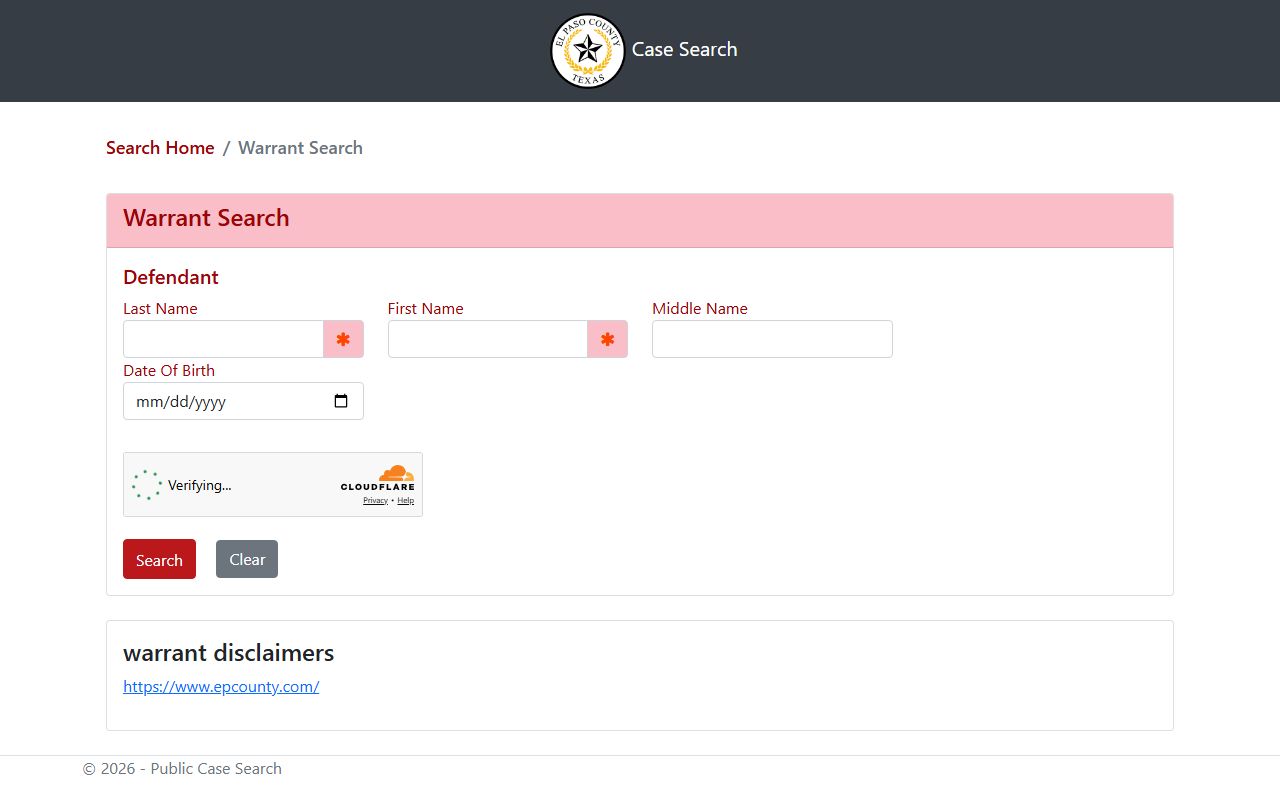
- Open the warrant search from the Records Search hub.
- Enter the exact last name and first name.
- Add a middle name and a date of birth if you have them, to narrow the result.
- Finish the Cloudflare security check.
- Click Search and review any match, then confirm it with the court or Sheriff.
You can also check the criminal case search to find the case behind a warrant. Set that tool to search by defendant or citation number to link a warrant to its underlying charge.
El Paso County Warrant Search Fields
The warrant search uses a short set of fields. Last and first name are required, and the rest help narrow a common name. The search will not run until the security check is complete.
| Field Label | Type | Required | Notes |
|---|---|---|---|
| Last Name | Text | Yes | Required to run the search |
| First Name | Text | Yes | Required to run the search |
| Middle Name | Text | No | Helps narrow common names |
| Date of Birth | Date | No | Narrows results further |
| Security Check | Cloudflare | Yes | Must be completed to submit |
What an El Paso County Warrant Record Shows
The public warrant search is built around name and date of birth, and the result detail can be limited on purpose. Sealed, juvenile, and active-investigation warrants may not appear at all. Because the portal uses a live security check, the exact result fields are confirmed only after a real search. The categories below describe what a warrant record generally involves, not a guaranteed public display.
| Field | What It Shows |
|---|---|
| Subject Name | The name the warrant is issued under. |
| Warrant Type | Arrest, bench, capias, or capias pro fine. |
| Issuing Authority | The court or the Sheriff's Office behind it. |
| Underlying Case | The criminal case the warrant connects to. |
| Status | Whether the warrant is still active. |
Note: Some details are withheld for safety, for sealed or juvenile matters, and for active investigations, so a public result may be brief.
What to Do If You Have an Outstanding Warrant
An outstanding warrant does not go away on its own, and ignoring it usually makes things worse. The safe path is to confirm the warrant, learn the underlying case, and resolve it through the right court, ideally with a lawyer's help. Acting on a rumor or a partial online result can lead to a surprise arrest.
- Search the official warrant portal using your exact name and date of birth.
- Check the criminal case search to find the underlying case and court.
- Call the court, clerk, or Sheriff's Warrants Section to confirm before you appear.
- If bond or release is involved, call the Downtown bonding line at 915-273-3767 or releasing at 915-273-3768.
- Talk to an attorney or the Public Defender if you qualify, before making statements about the case.
- Appear as directed, post bond if allowed, or ask the court for a setting.
After a warrant is resolved, give the systems time to update. Clearance is not always instant, so verify that the warrant is cleared before you rely on it. Keep any receipt, order, or release paperwork until the online record catches up, since that proof can resolve a mix-up if the warrant still appears active.
Reporting and Anonymous Tips
People sometimes want to report a wanted person rather than search for themselves. In El Paso County, the Sheriff's Office Warrants Section handles warrant service, and the non-emergency Sheriff line is 915-546-2280. For an emergency or a crime in progress, call 911 instead of a records line.
Be careful with anonymous tip claims you see online. Treat a public warrant result as a starting point, not a final answer, and let law enforcement confirm and act on it. A name match alone is not proof, since common names and data-entry errors are real.
How a Warrant Connects to Your El Paso County Case
A warrant rarely stands alone. It usually attaches to a criminal case, a citation, or a court order. A failure to appear can turn a simple ticket into a bench warrant or a capias. A missed payment in a fine-only case can produce a capias pro fine. A probation problem can trigger a warrant on the underlying conviction. Because of this, the warrant search and the criminal case search work best together.
To trace the link, run the warrant search by name, then open the criminal case search and look up the same person or citation number. A person can have a case with no active warrant, and a warrant can exist for reasons the case docket explains. Searching both systems gives the clearest picture before you contact the court.
Bonding and Magistration After a Warrant Arrest
When a warrant leads to an arrest, the process moves quickly. The person is booked into the Downtown Detention Facility, where a jail magistrate is on duty around the clock. The magistrate reviews the case, gives required warnings, and sets or reviews bond. Because two jail magistrate courts sit inside the jail itself, this can happen soon after booking.
Bond is the security or promise that allows release while a case is pending. Family or a bondsman can post bond through the Downtown bonding line at 915-273-3767, and questions about release go to 915-273-3768. A surety, the person or company responsible for a bond, can also surrender a defendant, which is its own kind of warrant. For who is in custody and how to reach a facility, see the El Paso County inmate records page.
Restricted El Paso County Warrant Records
Not all warrants are public. Sealed warrants, juvenile warrants, confidential victim matters, and warrants tied to active investigations may be withheld. Out-of-county and federal warrants will not appear in the county portal, since each system holds only its own records. A clean public search does not always mean no warrant exists.
When a public search is unclear, confirm with the Sheriff's Office or the court named on any paperwork you have. For the underlying charges, the arrest records and court records pages explain how to find the case.
A name match also is not proof by itself. Common names, shared birth dates, and data-entry errors can point to the wrong person. If you think a warrant record is wrong or belongs to someone else, do not ignore it. Contact the Sheriff's Office or the issuing court, bring identification, and ask how to correct the record or clear the matter the right way.