
County Courts at Law in El Paso County
County courts at law are statutory courts that the Legislature creates to take pressure off the district courts. In El Paso County they handle misdemeanors, mid-level civil suits, and many family cases, depending on the assignment. They are a step above the justice courts in the kinds of cases they hear, and a step below the district courts on the most serious matters.
El Paso County has several county courts at law, each with its own focus. Some hear civil and criminal cases, one focuses on family work, and a separate group of county criminal courts at law handles misdemeanor prosecutions. The framework for these courts comes from Texas Government Code Chapter 25.
Because the county court at law sits in the middle of the system, it carries a high volume of everyday cases. Many people who deal with the El Paso County courts will do so here rather than in a district court, since misdemeanors and smaller civil matters are far more common than felonies. That makes the county court at law an important first stop for understanding a case.
List of El Paso County Courts at Law
The roster below groups the county courts at law by focus. All sit in the downtown courthouse at 500 E. San Antonio Avenue, and the County Clerk keeps their records.
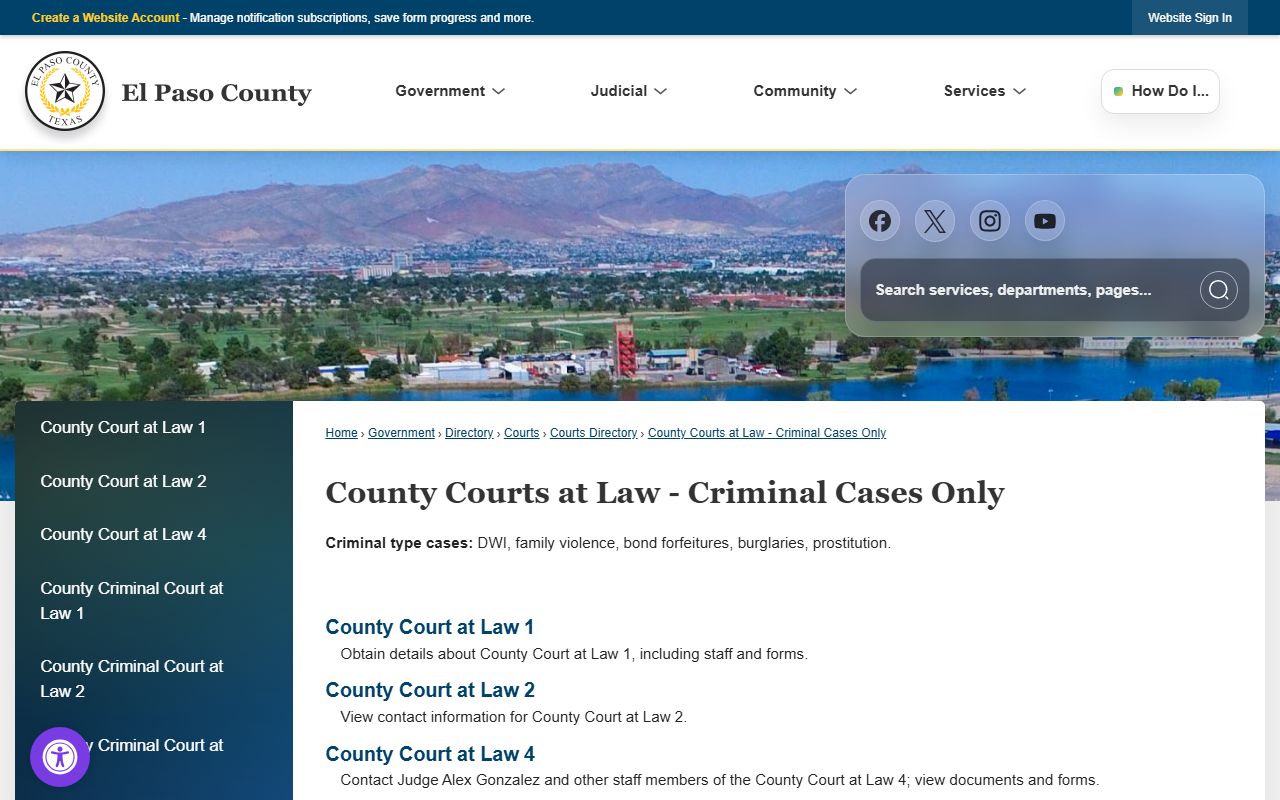
The county county courts at law page describes the criminal grouping. The roster follows.
| Court | Focus | Judge |
|---|---|---|
| County Court at Law 1 | Criminal | Not listed |
| County Court at Law 2 | Civil and criminal | Julie Gonzalez |
| County Court at Law 3 | Civil and criminal | Melissa A. Baeza |
| County Court at Law 4 | Criminal | Alex Gonzalez |
| County Court at Law 5 | Family | Not listed |
| County Court at Law 6 | Civil and criminal | M. Sue Kurita |
| County Court at Law 7 | Civil and criminal | Not listed |
| County Criminal Courts at Law 1-4 | Misdemeanor criminal | Incl. Jessica Vazquez (No. 4) |
Reach these courts through the County Clerk at 915-273-3532. Direct lines include County Court at Law 2 at 915-273-3730, No. 3 at 915-273-3721, and No. 6 at 915-273-3720.
What El Paso County Courts at Law Handle
The county courts at law carry a broad mix. On the criminal side, county court examples include DWI, family violence, bond forfeitures, burglaries, and prostitution cases. These are mostly misdemeanors, the Class A and Class B offenses that sit below felonies.
On the civil and family side, county courts at law hear mid-level money disputes and assigned family matters. Some appeals from justice courts also land here. The exact mix depends on the court's assignment, which is why two county courts at law can carry very different dockets.
- Misdemeanor criminal cases, including DWI and family violence
- Mid-level civil disputes
- Assigned family law matters
- Appeals from justice and municipal courts
- Bond forfeitures and related proceedings
A single county court at law can shift its docket over time as the county reassigns work. The label civil and criminal means the court can take both, not that every case is split evenly. When in doubt, the case search shows which court actually holds a matter, so you do not have to guess from the court name alone.
Misdemeanor Classes in Texas
Most county court at law criminal cases are misdemeanors, and Texas sorts them into classes. A Class A misdemeanor is the most serious, a Class B sits below it, and a Class C is a fine-only matter handled in justice or municipal court rather than a county court at law. The class affects the possible penalty and which court hears the case.
A Class A or Class B misdemeanor can carry jail time, a fine, probation, and a lasting record. That is why a misdemeanor case still deserves real attention, and why many defendants seek counsel. The county court at law is where these Class A and Class B cases are tried and resolved, while the Class C cases stay in the lower courts.
- Class A misdemeanor
- The most serious misdemeanor level, with the highest jail and fine exposure.
- Class B misdemeanor
- A mid-level misdemeanor, still able to carry jail time.
- Class C misdemeanor
- A fine-only offense heard in justice or municipal court.
County Court vs District Court vs Justice Court
The three trial levels divide the work by seriousness and case type. A county court at law sits in the middle. Seeing them side by side helps you find the right court.
| County Court at Law | District Court | Justice Court | |
|---|---|---|---|
| Criminal | Misdemeanors | Felonies | Class C, fine-only |
| Civil Reach | Mid-level | Higher-value and general | Up to $20,000 |
| Family Cases | Some | Yes | No |
| Records Keeper | County Clerk | District Clerk | Justice Court |
For the levels above and below, see the District Court and Justice of the Peace pages. The jury size also differs by level, with a county court at law using a six-person jury.
County Criminal Courts at Law
El Paso County also runs a separate set of county criminal courts at law, numbered one through four. These courts focus on misdemeanor prosecutions, which keeps the criminal docket moving and lets the other county courts at law carry civil and family work. County Criminal Court at Law No. 4 is among those listed with a sitting judge.
Misdemeanors still carry real consequences, including jail time, fines, probation, and a record. A misdemeanor DWI or family violence case, for instance, can affect a job, a license, or future cases. The records for these cases run through the County Clerk Criminal Division.
For a defendant, the practical questions are the same in any of these courts. What is the charge, what is the bond, when is the next setting, and is counsel appointed. The county criminal courts at law handle that day-to-day flow for misdemeanors, often in high volume, which keeps the system moving for the most common cases.
How to Search County Court at Law Cases
County court at law cases are searched through the county's online case search, the same system used for district court cases. Criminal cases use the criminal case search, and civil, family, and probate matters use the civil, family, and probate search. Both run on the county Odyssey platform.
- Open the county Records Search hub and pick the criminal or civil search.
- Set the Search By method to Case, Defendant, or Party.
- Enter the case number, or a last and first name with a date range.
- Finish the security check and open the matching case.
For the full walkthrough and field tables, see the court records page.
If you do not know the court, that is fine. The search is built around the case and the person, not the court number, so a name or case number will surface the assigned court for you. Add a date of birth or a date range when a common name returns several results, and use the citation search for a ticket-based case.
The County Clerk's Role
The County Clerk is the records keeper for the county courts at law and the statutory probate courts. Misdemeanor copies, county-court civil files, and related records run through the County Clerk Criminal Division and Probate-Civil Division. Certified copies come from the County Clerk, not the district court office, so a request sent to the wrong clerk will simply come back empty.
For office hours, locations, and request methods, see the County Clerk page. For felony and district-court matters, the District Clerk is the right office instead.
Appeals and Case Flow
A case can move up from a county court at law. Appeals generally go to the Eighth Court of Appeals, the same intermediate court that hears district court appeals from El Paso. The county courts at law also receive some appeals from below, since cases tried in justice and municipal courts can be appealed to a county-level court.
So the county court at law sits in the middle of the flow, taking appeals from the lowest courts and sending its own appeals up. The case ladder runs from justice court to county court at law to district court and then to the appellate courts. Because of that middle position, a single dispute can touch more than one court level before it ends.